
The next evolution in coatings: slicker, harder, and more heat-resistant than ceramic.
The Protocol
Ceramic coating changed what car owners expected from paint protection. Graphene coating is the next step.
A surface that repels water, resists contamination, and holds its gloss for years without reapplication was a significant step forward from wax and sealants.
Graphene coating is the next step.
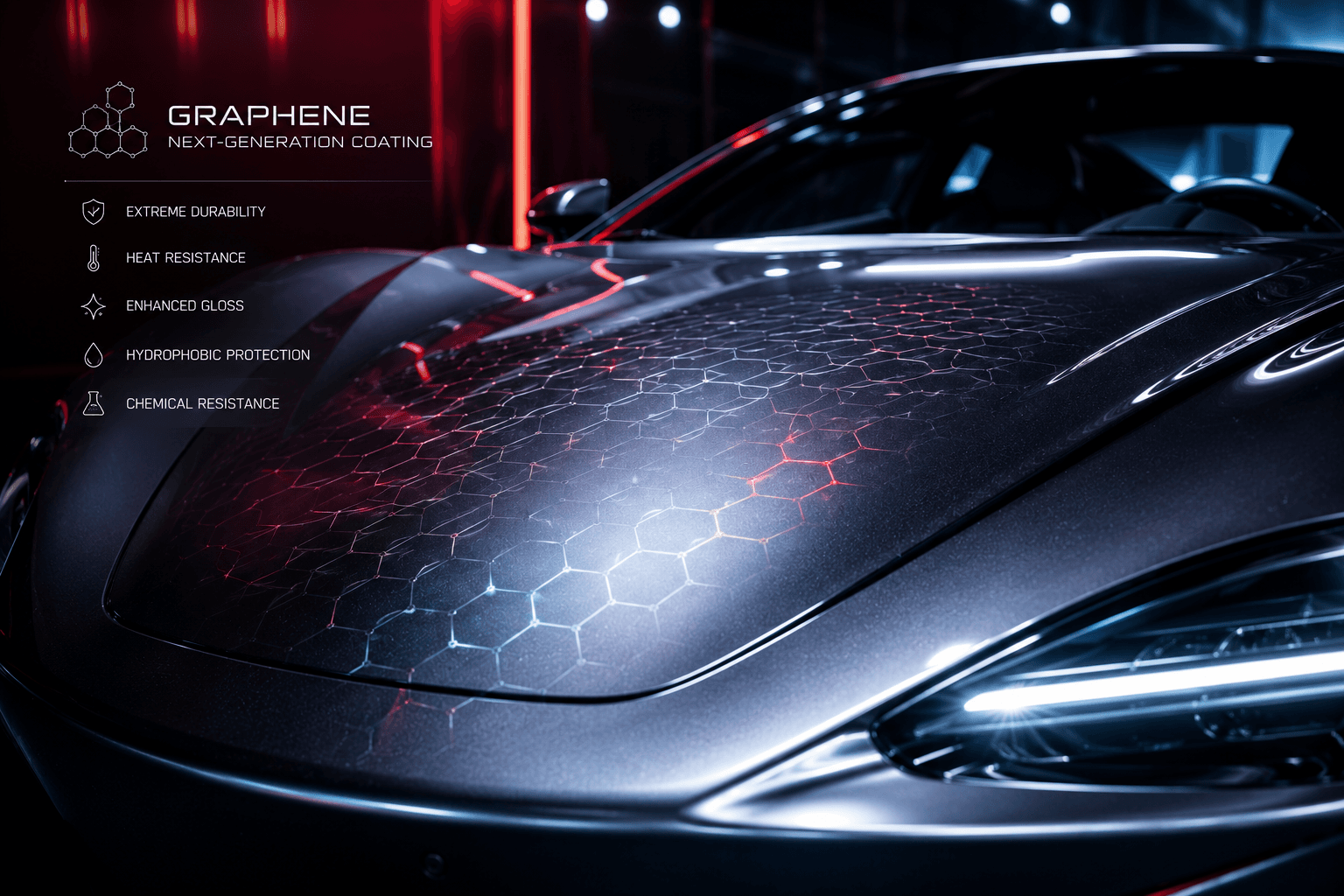
The same fundamental principle applies. A coating bonds chemically to your car's paint and forms a protective layer that outlasts anything you can apply and wipe off. What changes is the material. Graphene, a single layer of carbon atoms arranged in a lattice structure, is among the hardest and most thermally conductive materials known. When it is incorporated into a coating formulation and applied to paint, the result is harder, more heat-resistant, more flexible, and longer-lasting than conventional ceramic.
At AutoGlow, we apply graphene coating to the same exacting preparation standards we bring to every protection service. Serving car owners in Ahmedabad and Kochi.
The differences between graphene and ceramic coating are not marketing language. They are material properties that show up in real conditions over real time.
Graphene coating's heat dissipation advantage was made for cities like Ahmedabad. Summer temperatures here are not just uncomfortable for the people inside the car. They are genuinely damaging to the paint outside it. A coating that actively manages surface heat rather than trapping it addresses one of the most significant causes of premature paint deterioration in this climate.
In Kochi, the combination of humidity, salt air, and months of monsoon driving creates conditions where water spot formation and surface contamination are ongoing concerns. Graphene's superior water spot resistance and hydrophobic properties make it a more capable solution for coastal conditions than ceramic alone.
Both cities demand more from a coating than temperate climates do. Graphene is built for exactly this kind of demand.
Graphene coating is at least as unforgiving as ceramic when it comes to surface preparation, and the stakes are higher because the coating bonds more durably. Whatever is on the paint when the coating goes on stays there.
Every vehicle coming in for graphene coating at AutoGlow goes through a full paint inspection under proper lighting. Surface contamination is removed completely. Any swirl marks, light scratches, or oxidation are machine polished out before the coating is applied. The paint needs to be in the best condition it can be before anything goes on top of it.
The coating is then applied in a controlled environment, panel by panel. Coverage, levelling, and cure time are all managed precisely. The process is not fast and it is not meant to be.
Ceramic coating is not a bad product. It is a very good one. For many owners it remains the right choice depending on their budget and their specific requirements.
Graphene coating is better in measurable ways. Harder surface. Better heat management. Greater water spot resistance. More flexibility over time. Longer durability under demanding conditions.
The gap is meaningful in Indian conditions where heat, dust, and humidity test a coating far harder than temperate climates do. If you are making a long-term investment in your paint's protection, graphene is the more capable product.
Book a consultation with AutoGlow. We will inspect your paint, walk you through what preparation it needs, and give you a complete picture before anything is decided.
Frequently Asked Questions
Is graphene coating actually better than ceramic or is it just newer?
The differences are material and measurable, not just marketing. Hardness, heat dissipation, water spot resistance, and flexibility are all genuinely improved in graphene formulations. In moderate climates the gap is smaller. In Indian conditions, particularly in cities like Ahmedabad, the heat dissipation advantage alone makes graphene the more appropriate choice.
How long does graphene coating last?
Longer than ceramic under comparable conditions. We will give you a specific and realistic picture during the consultation based on your vehicle, how you use it, and how you maintain it.
Does graphene coating prevent stone chips?
No. Like ceramic, graphene coating adds hardness and scratch resistance but is not a physical impact barrier. For stone chip protection, PPF remains the right solution. Graphene coating and PPF work well together, with PPF on high-impact zones and graphene coating over the full car.
Does my car need paint correction before graphene coating?
If the paint has swirl marks, scratches, or oxidation, yes. We will not apply coating over compromised paint. Correction comes first. We assess this during the consultation and handle it as part of the process.
Can graphene coating be applied over PPF?
Yes. Graphene coating over PPF adds hydrophobic properties and enhances the clarity and gloss of the film. It is a combination that makes sense for owners who want the most complete protection available.
Do you serve both Ahmedabad and Kochi?
Yes. Contact us to book a consultation at your preferred location.
Ready to transform your vehicle?
Book a consultation with AutoGlow. We will walk you through finish options and give you a complete picture before anything is decided.